
PRE-ORDER: Transgresoras: Mail Art and Messages, 1960s–2020s
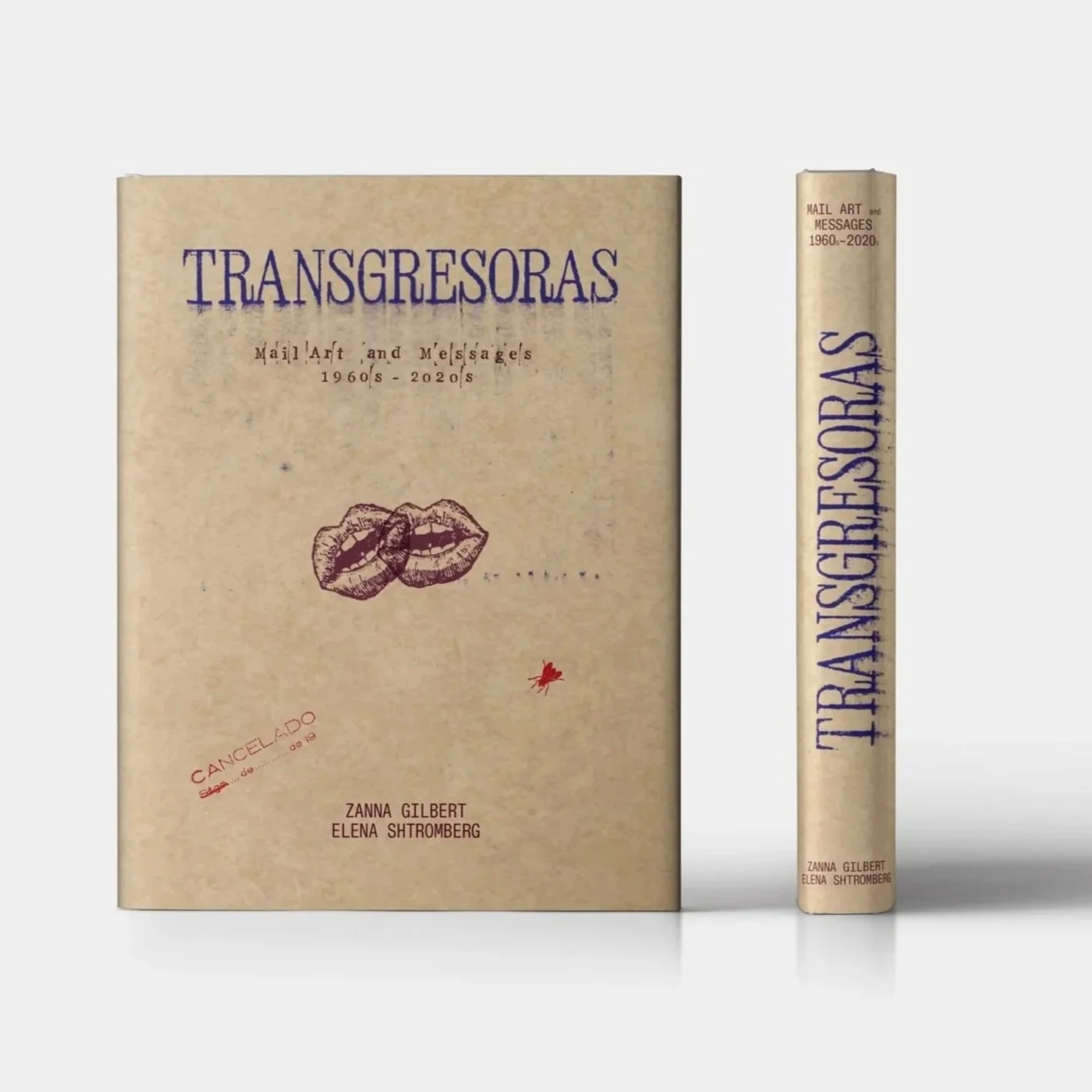
PRE-ORDER: Transgresoras: Mail Art and Messages, 1960s–2020s
Editors: Dr. Zanna Gilbert, Dr. Elena Shtromberg
Foreword: Joanna Szupinska
Contributing Authors: Dr. Zanna Gilbert, Dr. Elena Shtromberg, Dr. C. Ondine Chavoya, Mela Dávila Freire, Dr. Paula V. Kupfer, Margarita Lizcano Hernandez, Dr. Madeline Murphy Turner, Alexandra Schoolman, Dr. Rachel Vogel
Translators: Lia Quezada, Audrey Young
Design: MJ Balvanera, Andrea García Flores (Impresos México)
Co-published in 2026 with California Museum of Photography at UCR ARTS, Riverside and with generous support from the Getty Research Institute Council, Terra Foundation for American Art, Art Bridges, and Betty Duker.
11 × 8.5 inches (27.9 × 21.6 cm), hardback
ISBN: 9781970443196
Upcoming: to be released in Fall, 2026
A reminder for our European customers that you will be able to order in Europe from Les Presses du Réel after publication.
Transgresoras: Mail Art and Messages, 1960s–2020s is a survey of Latinx and Latin American women artists that used mail art, postal networks, messages, and distribution in their work. By working outside of traditional gallery and museum structures, the featured artists transgressed gender norms and oppressive political and artistic systems to evade the dominant art world’s capitalistic structures and, in many historical cases, undermine the censorship of authoritarian regimes. This richly-illustrated publication includes texts that examine the cultural and historic importance and impact of key mail artworks.
This publication stems from the exhibition Transgresoras: Mail Art and Messages, 1960s–2020s which presented pivotal mail art works—including visual poetry, drawings, prints, performance, video, and photography—in dialogue with the work of younger artists who also use tools of correspondence in their artworks. This intergenerational approach foregrounds overlooked and groundbreaking artistic practices across Latin America to present a lineage of artistic production that enhances our perspective on the issues of today’s media and political landscape.
This publication and the exhibition were edited and curated by Dr. Zanna Gilbert, Senior Research Specialist, Getty Research Institute, and Dr. Elena Shtromberg, Professor of Art History, University of Utah, for UCR ARTS at University of California, Riverside in collaboration with the Getty Research Institute. The exhibition took place at UCR ARTS and the California Museum of Photography from September 2025 to February 2026.
Featured artists include Anna Bella Geiger, Cecilia Vicuña, Graciela Gutiérrez Marx, Liliana Porter, Magali Lara, Marta Minujín, Mónica Mayer, Regina Silveira, Rosa de la Montaña (aka Teddy Sandoval), Virginia Errázuriz, as well as a younger generation of artists, such as Amalia Pica, Beatriz Cortez, Carmen Argote, Carolina Caycedo, Clarissa Tossin, Gala Porras-Kim, Giana de Dier, Marilyn Boror Bor, Regina José Galindo, and Voluspa Jarpa, among others.
Dr. Zanna Gilbert is a senior research specialist at the Getty Research Institute. Her research focuses on transnational conceptual art, feminisms, and the international mail art network, with a particular focus on Latin America. She received an AHRC Collaborative Doctoral Award to complete her PhD at the School of Philosophy and Art History at the University of Essex and Tate Research, where she researched and wrote about the museum’s collections of Latin American art. She was previously an Andrew W. Mellon postdoctoral fellow in the Department of Drawings and Prints at the Museum of Modern Art (MoMA) in New York, where she led research on Latin America and was founding co-editor of the online publication post: notes on modern and contemporary art around the globe. At the Getty, she is co-lead of the Latin American and Latinx Art History Initiative (LALAI) and several research projects. She is co-curator of the exhibition Transgresoras: Mail Art and Messages, 1960s–2020s (California Museum of Photography, UCR ARTS, 2025–26), as well as How to Be a Guerrilla Girl (Getty Research Institute, 2025–26). She is co-editor of the publication Ed Ruscha's Streets of Los Angeles: Artist, Image, Archive, City (2025) and is currently working on an exhibition and publication titled Pioneers of a New Image: Women Artists and Xerography, forthcoming in 2027–28.
Dr. Elena Shtromberg is professor of art history at the University of Utah, specializing in contemporary Latin American visual culture. Her book Art Systems: Brazil and the 1970s (University of Texas Press, 2016) explores visual forms of critique and subversion during the height of the Brazilian dictatorship. She has curated a number of exhibitions, among them Video Art in Latin America at LAXART, co-curated as part of the Getty Foundation’s initiative PST: LA/LA in 2017 accompanied by the co-edited volume Encounters in Video Art in Latin America (Getty Publications, 2023). Most recently, she co-curated Transgresoras: Mail Art and Messages, 1960s–2020s, focusing on an intergenerational group of Latin American and Latinx women artists working with mail art at the California Museum of Photography (September 2025).
Joanna Szupinska is senior curator at UCR ARTS: California Museum of Photography and Culver Center of the Arts, part of the University of California, Riverside.
Dr. C. Ondine Chavoya is the John D. Murchison Regents professor of art in the Department of Art and Art History at University of Texas, Austin. A specialist in contemporary art and Latinx art, Chavoya is co-editor of Chicano and Chicana Art: A Critical Anthology. With David Evans Frantz, Chavoya co-curated Axis Mundo: Queer Networks in Chicano L.A., a groundbreaking exhibition and archival research project that traveled to eight venues across the United States from 2017 to 2022. With Rita Gonzalez, Chavoya was co-curator of the earlier exhibition Asco: Elite of the Obscure, A Retrospective, 1972–1987 that opened at LACMA in 2011. More recently, he co-organized the traveling exhibition Teddy Sandoval and the Butch Gardens School of Art. He is the recipient of a 2021 Andy Warhol Foundation Arts Writers Grant and was a 2023–24 MoMA Scholar in Residence.
Mela Dávila Freire is a researcher, curator, writer, and translator. Her research focuses on art archives and the genre of artists’ publications. Her specific interests include the feminist revision of the history of artists’ publications, the theoretical and practical intersections between archives and art collections, and the ideological biases hidden in archival structures. She has been Head of Publications and Head of the Study Center at the Museu d'Art Contemporani de Barcelona (MACBA), and Director of Public Activities at Museo Reina Sofía. She has collaborated with documenta Archive (Kassel), the Museum of German History (Berlin), the Lafuente Archive (Santander), the Reina Sofía Museum (Madrid), the Institut Valencià d’Art Modern – IVAM (Valencia), the Biblioteca de las Artes (Guayaquil), and other public and private institutions and collections. She is the author of Mission and Commission: Documenta and the Art Market, 1955–1968 (Polígrafa, 2022) and Off-Register: Publishing Experiments by Women Artists in Latin America, 1960–1990 (Center for Book Arts, 2023).
Dr. Clara Garavelli is an associate professor in Latin American studies at the University of Leicester (UK), specializing in Argentine visual culture. She has published extensively, including Video Experimental Argentino Contemporáneo: Una cartografía crítica (EDUNTREF, 2014) and Ricardo Darín and the Construction of Latin American Film Stardom (EUP, 2023). She has curated exhibitions in Argentina, Brazil, and the UK, and has served as a jury member for festivals in Argentina and Spain. She sits on the editorial board of Secuencias (UAM, Spain), is the research director of Ubicua Gallery (London, UK), and is a member of both the DeVisiones research group (Spain) and the art-tech collective Legado.ar (Argentina). Additionally, she holds the position of co-executive of the Graciela Sacco Estate.
Dr. Paula V. Kupfer is an art historian and writer specializing in the history of photography, modern art, and contemporary video practices in Latin America. Her research and teaching emphasize the ecological, political, and racial dimensions of landscape representations, as well as the mobility of artworks, artists, and ideas. Her writing has appeared in ASAP/J, Hyperallergic, Terremoto, The Photobook Review, Harper’s “Postcard” blog, BOMB online, TIME LightBox, and the Aperture blog, among others. Formerly the managing editor of Aperture magazine, she is currently a teaching assistant professor of art history at the University of Pittsburgh.
Margarita Lizcano Hernandez is a curatorial associate in the Department of Drawings and Prints at MoMA, New York. Her curatorial work centers on the role of print media in fostering artistic networks and collaborations during the late twentieth century across North and South America. At MoMA, she has helped organize and contributed scholarship for the exhibition and catalog projects Barbara Kruger: Thinking of You. I Mean Me. I Mean You, New Ground: Jacob Samuel and Contemporary Etching, and Vital Signs: Artists and the Body. She is currently working on a forthcoming monographic exhibition of Eva Hesse, focusing on her early prints. Prior to MoMA, she held curatorial positions at the Solomon R. Guggenheim Museum’s Guggenheim Abu Dhabi Project and the Art Institute of Chicago. She holds a BA in Art History from the School of the Art Institute of Chicago and an MA in the history of art from the Courtauld Institute of Art, London.
Dr. Madeline Murphy Turner is a curator and art historian whose practice centers on contemporary art of the Americas. Her research, writing, and exhibitions prioritize topics of gender and ecology in relation to transhistorical politics. She has held curatorial positions at the Harvard Art Museums, MoMA, and the Grey Art Museum, and has published essays in exhibition catalogues, research volumes, and journals, including Latin American and Latinx Visual Culture. Dedicated to the power of arts education, Madeline is a board member of La Escuela___, an artist-run platform for radical learning and collective making in public spaces. She is also the co-editor of Momentum: Art and Ecology in Contemporary Latin America (The Museum of Modern Art, 2025), an award-winning anthology that investigates how Latin American artists engage with their natural environments. She holds a PhD in art history from the Institute of Fine Arts, New York University.
Alexandra Schooman is a PhD candidate in art history at Temple University, Philadelphia. Her research interests include conceptualism and social practice, particularly as they address the intersection of human and environmental rights, with a focus on Latin American art. Her dissertation reevaluates conceptualist political art from the dictatorial periods of Argentina, Brazil, and Chile through an ecocritical lens. Her research has been supported by grants, including the Marcia Hall Research Award and the Temple Graduate School Summer Research Grant. She was formerly the Exhibitions Manager at Henrique Faria, New York, where she curated the 2019 exhibition, Art at a Distance: Mail Art in Latin America, 1969–2019. She has also curated exhibitions in New York, Philadelphia, Miami, and Mexico City.
Dr. Rachel Vogel is the assistant curator at the Addison Gallery of American Art, where she focuses on modern and contemporary art. Recent exhibitions include Tommy Kha: Other Things Uttered, On and Off Stage: Performance and Persona, Figure/Ground, Reggie Burrows Hodges: Turning a Big Ship, and the forthcoming Parasol Press: Breaking New Ground. Rachel received her PhD in the history of art and architecture from Harvard University, where her dissertation highlighted the important role of printmaking for conceptual artists in the 1960s and 1970s. Her writing has been published in American Art, Art Journal, caa.reviews, Oxford Art Journal, Print Quarterly, and in exhibition catalogs for the Addison, Print Center New York, and the Radcliffe Institute for Advanced Study.
MJ Balvanera is a graphic designer born and raised in CDMX, Mexico. She believes that graphic design can be more than just a series of arbitrary visual standards, a fun means of individual and cultural expression. The main focus of her work is publishing.
Andrea García Flores is an editorial and graphic designer from Ciudad Madero, Tamaulipas, Mexico. Her practice focuses on feminism, self-publishing, and teaching workshops that integrate DIY publishing and disseminate independent editorial practices. She believes in editorial design as a tool for resistance, collaboration, and community building, exploring alternative publishing methods beyond traditional formats.
The California Museum of Photography at UCR ARTS is part of University of California, Riverside. Through exhibitions, programming, and research, UCR ARTS activates photography and contemporary arts to foster curiosity, spark critical dialogue, and build community.